Epson EcoTank ET-2400 vs ET-2800: Two Entry Tanks, One Decision
Updated
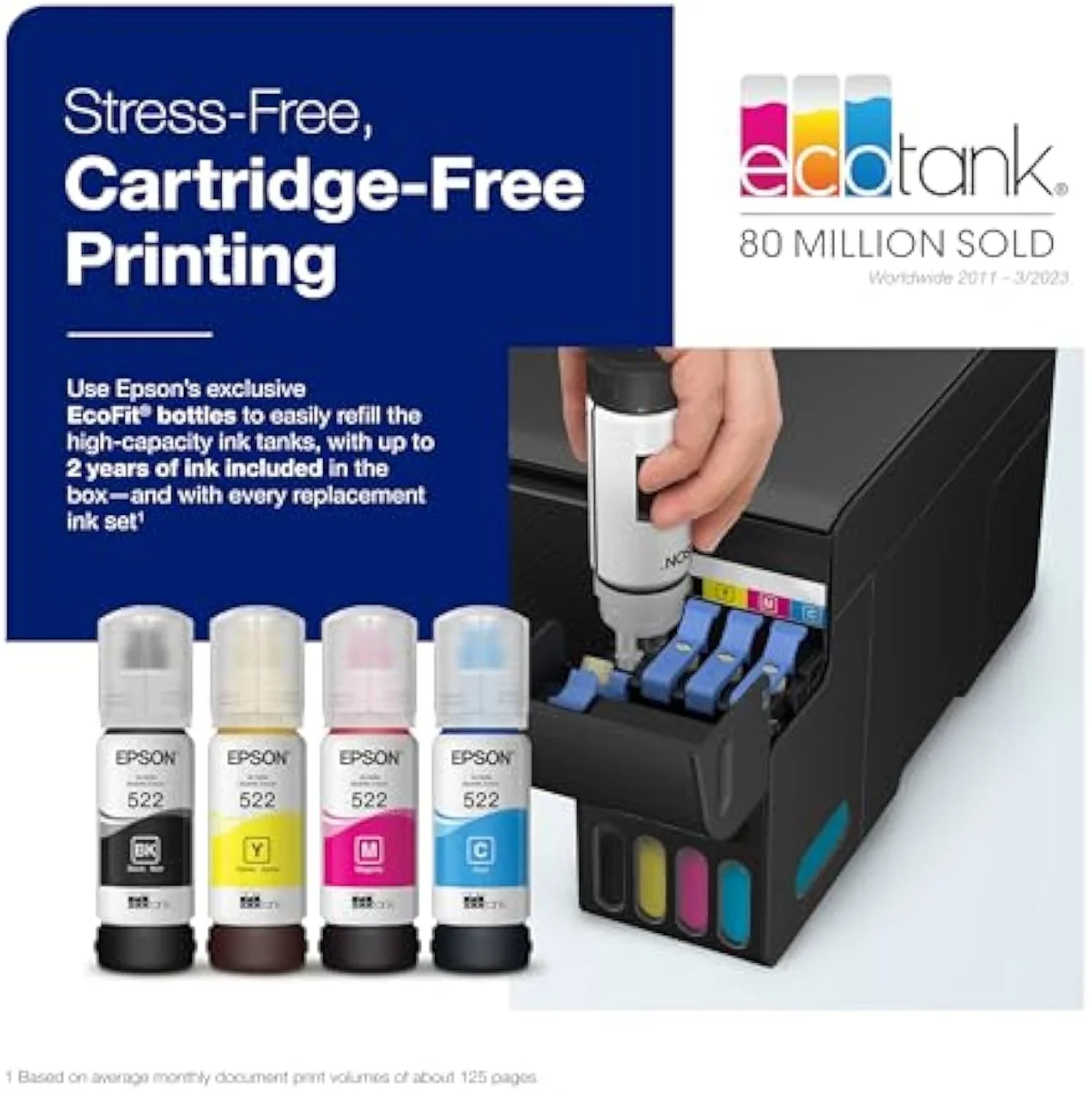
These are two entry EcoTanks a generation apart, and the gap is small. The ET-2800 carries a slightly higher resolution and a deeper owner record; the ET-2400 is usually the cheaper number. But the ink system, the 4,500/7,500 in-box yield, and the cartridge-free bottles are identical, so cost-per-page is a dead heat. Take the ET-2800 at an equal price for the longer track record; otherwise buy the cheaper tank, and put your real attention on whether a supertank suits how often you print.
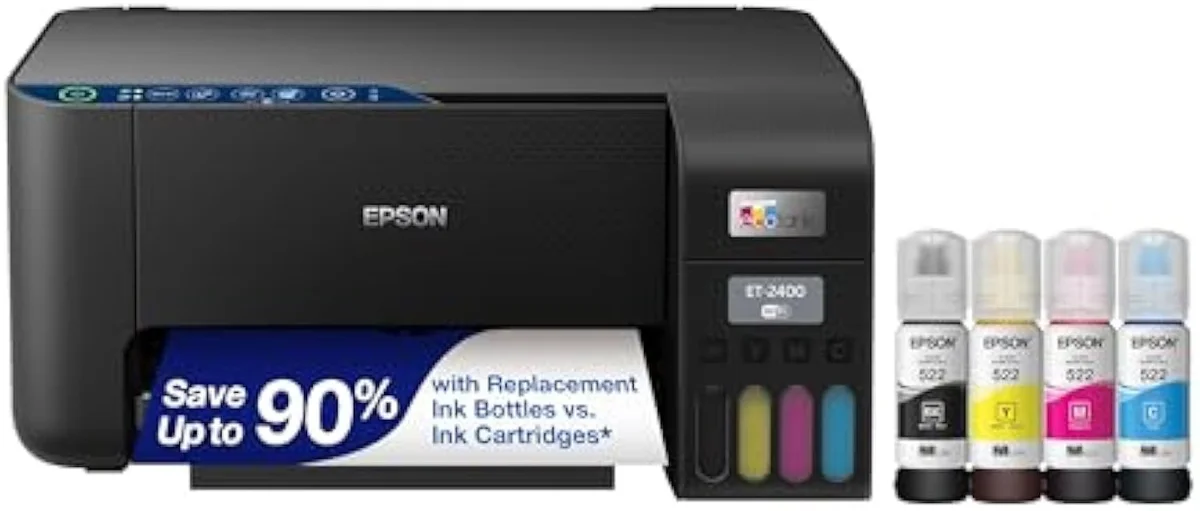
Epson® EcoTank ET-2400 Wireless Inkjet All-In-One Cartridge-Free Supertank Co…
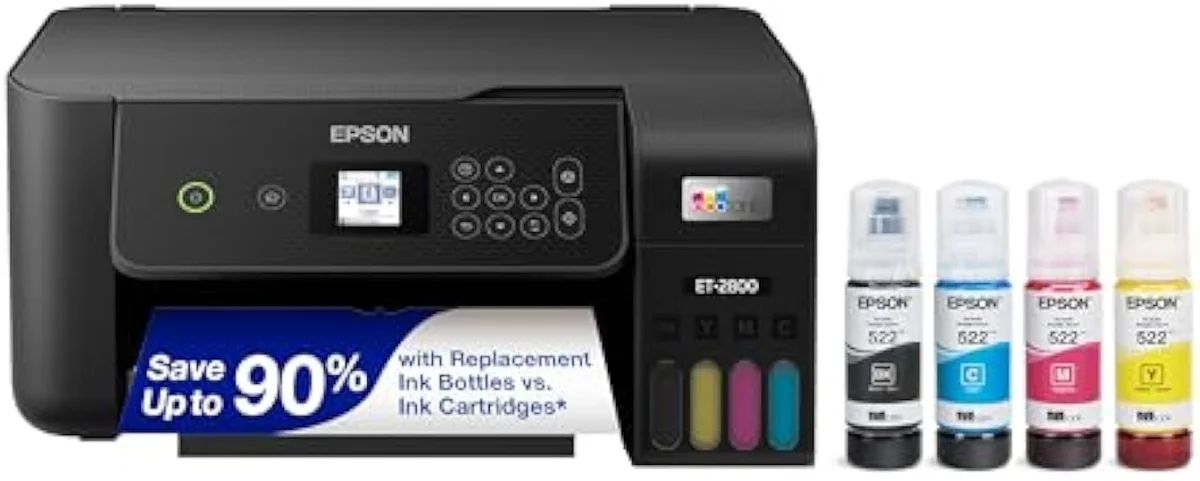
Epson EcoTank ET-2800
The ET-2400 and ET-2800 are two entry EcoTanks a generation apart. They share the same bottle ink, the same 4,500/7,500 in-box yield, and the same idle-clog risk — so cost-per-page is identical. The ET-2800 adds a slightly higher resolution and a deeper owner record; the ET-2400 is usually cheaper. Buy on price; the only decision that matters is supertank versus cartridge.
| What the ET-2800 adds | Slightly higher resolution, far deeper owner record |
|---|---|
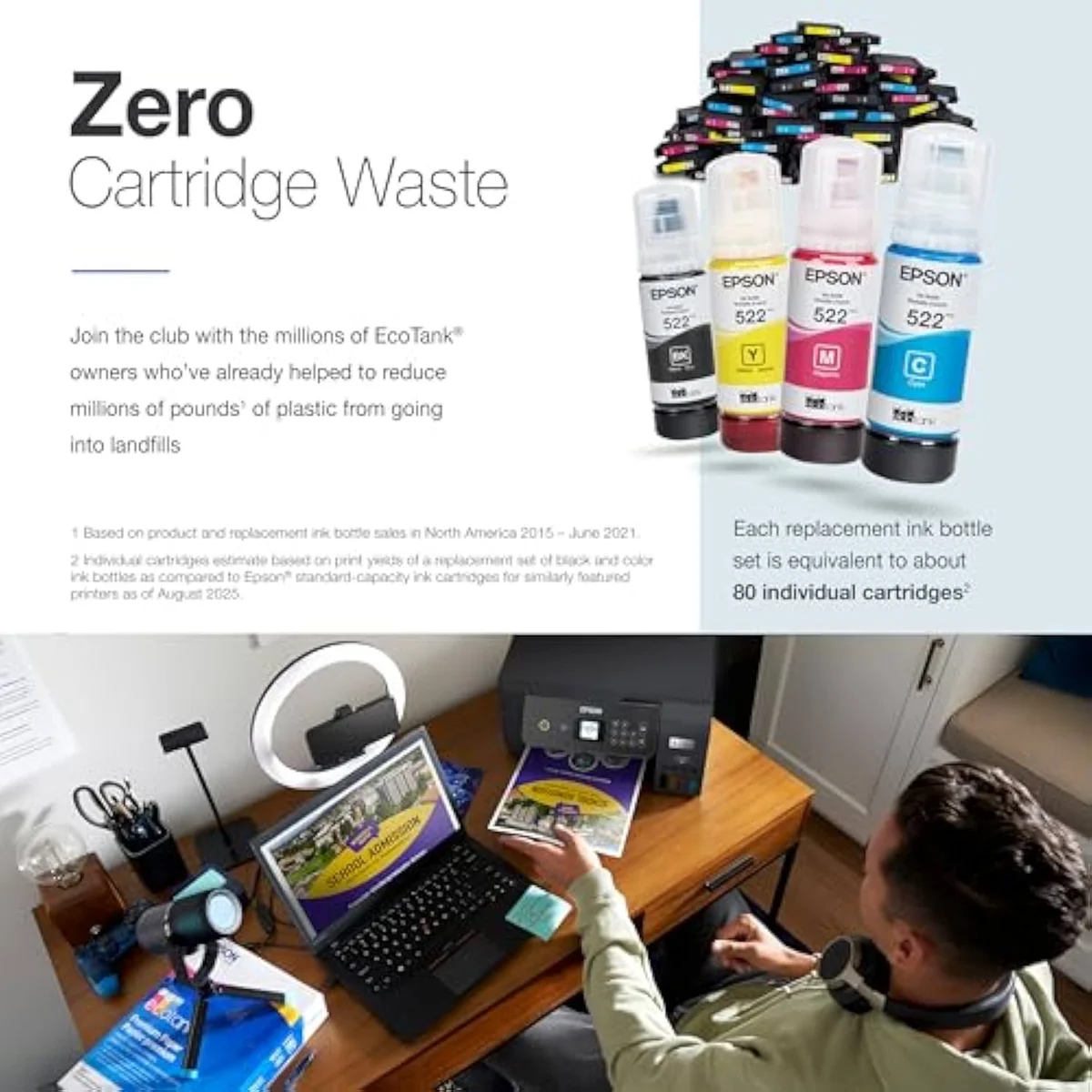
| Shared core | Same bottle ink, same 4,500/7,500 yield, same ~80-cartridge pitch |
| Shared weakness | Idle clogging + manual duplex, both |
| How to choose | Take the ET-2800 at an equal price; else the cheaper tank |
| Skip both if | You print twice a year — clog risk outruns the ink savings |
Search “Epson ET-2400 vs ET-2800” and you expect a real fork. You get a near-tie. These are two entry EcoTanks a generation apart — both cartridge-free, both filling from bottles, both quoting the same in-box page yield. The ET-2800 is the established base model with a slightly higher print resolution and thousands of owner reviews behind it; the ET-2400 is the cheaper, newer-numbered sibling that prints the same pages for the same ink money. So the literal answer is simple: at an equal price, take the ET-2800 for the longer record; otherwise buy whichever tank costs less.
Here's the thing, though. The gap between these two is small enough that price should settle it, not the spec sheet. The ink, the yield, the clog risk — all shared. What actually decides where your money goes is the question the model numbers hide: is a bottle-fed supertank right for you at all? That is where this page spends its time.
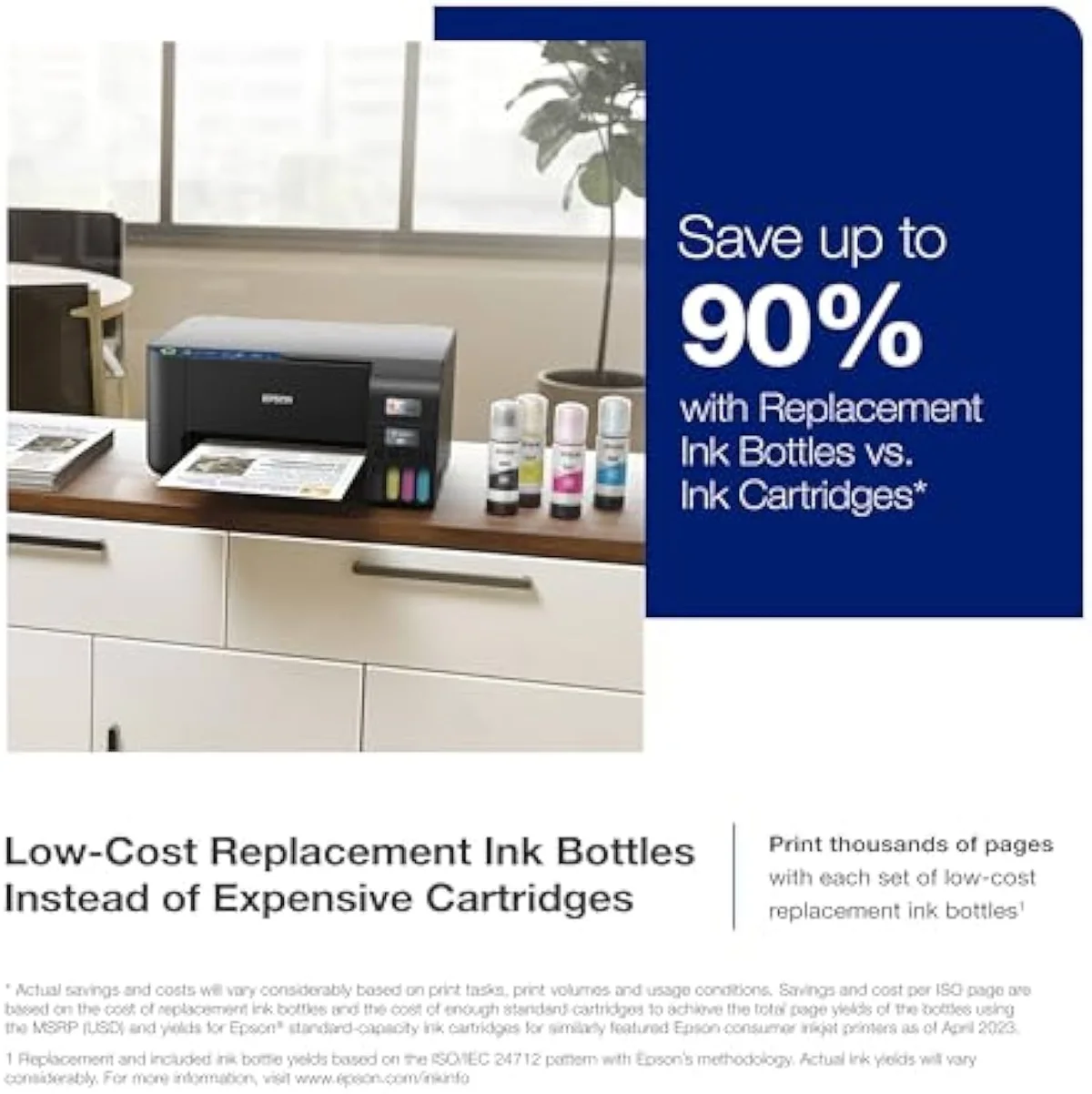
Epson® EcoTank ET-2400 Wireless Inkjet All-In-One Cartridge-Free Supertank Co…
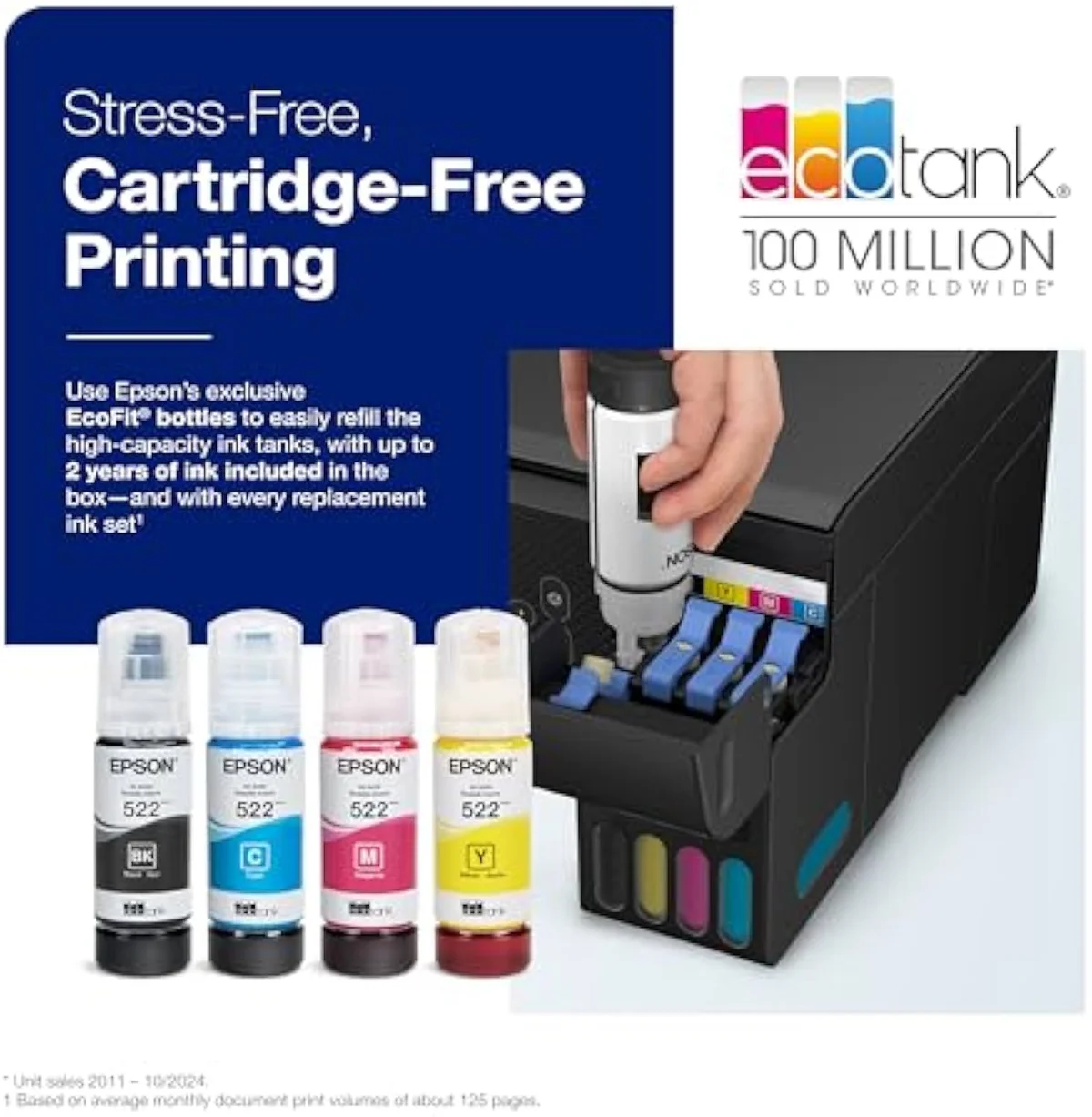
Epson EcoTank ET-2800
At a Glance
| Feature | Epson® EcoTank ET-2400 Wireless Inkjet All-In-One Cartridge-Free Supertank Co… | Epson EcoTank ET-2800 Wireless Color All-in-One Cartridge-Free Supertank Printer |
|---|---|---|
| Live Price | $100–$250* | $50–$100* |
| Amazon Savings | Check Amazon | Check Amazon |
| Availability | Checking Amazon | Checking Amazon |
| Current Offer | Checking Amazon | Checking Amazon |
| Amazon Rating | ||
| Amazon Sales Rank | Check Amazon | Check Amazon |
| Live Data Refresh | Refresh pending | Refresh pending |
| Print Speed | — | Up to 10 ppm black |
| Functions | — | Print, Scan, Copy |
| Connectivity | — | Wi-Fi, AirPrint, Smart Panel app |
| Ink System | — | Cartridge-free refillable tanks |
| Check Price | Check Price |
Amazon prices and availability are refreshed live and are subject to change. The price shown on Amazon at purchase applies.
Where the price gap buys you nothing
On the spine of any supertank — the ink economics — these two are the same machine. Both ship cartridge-free and quote the identical in-box rating. Epson prints, on the ET-2400 listing, that the included ink is
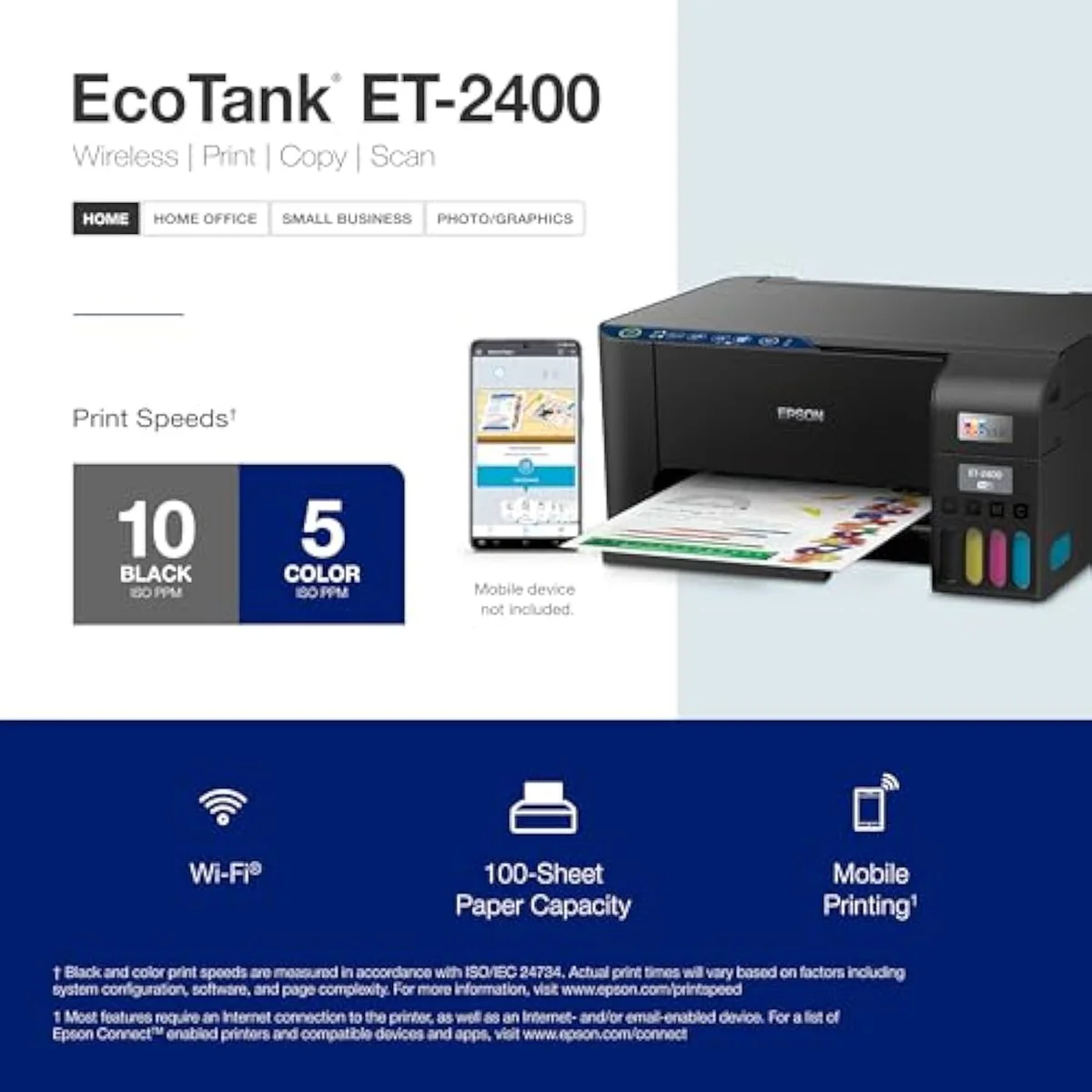
The capability list matches almost line for line. The ET-2800 runs Epson's print engine that
So where does the price gap actually go? Two places, and neither touches running cost. The ET-2800 quotes a slightly higher print resolution on the box, and it arrives with thousands more owner reviews behind it — a longer paper trail of how it holds up. The ET-2400 trades that proven record for a lower sticker. One shared limit is worth naming before you pick either: neither does automatic two-sided printing. Epson's own note on the ET-2400 is that
The one number both stake everything on
The 4,500-black / 7,500-color yield both EcoTanks print on the box is the number owners distrust most — and rightly, because a supertank's real yield depends entirely on how you use it. We weigh that idle-resilience axis directly in our inkjet comparison criteria, and it is the line that should decide whether either of these belongs on your desk.
For a steady printer the box number holds up. One ET-2800 owner who prints full pages of color regularly reported still having about half the in-box ink left after roughly a year of use. That is the supertank dream working as advertised — and because the ET-2400 carries the identical tank and bottle set, the same yield applies to it. The savings against a cartridge machine are not marketing for a household that prints every week.
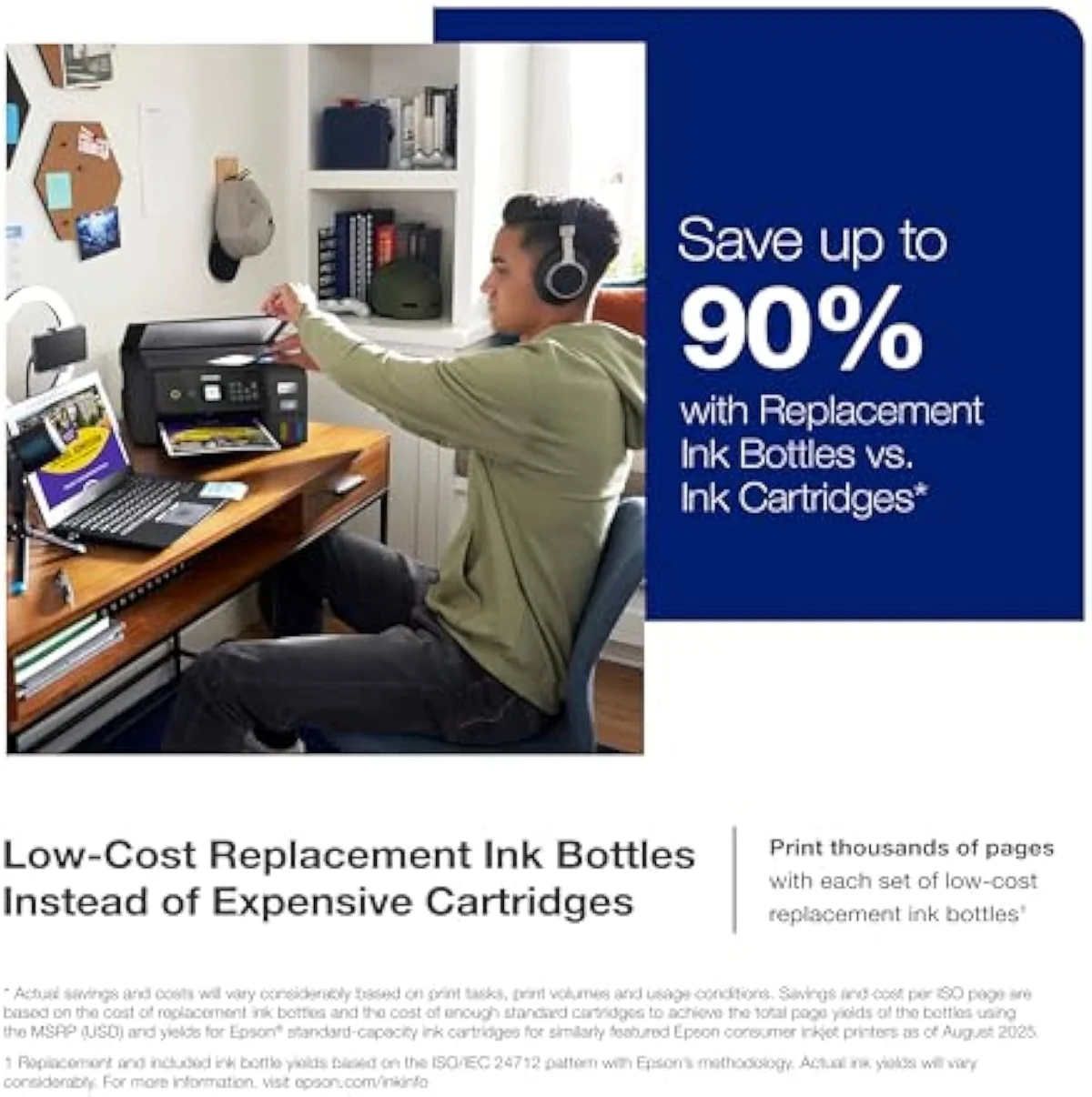
The running-cost case is strong against cartridges, and the same for both tanks. RTINGS' cost-per-print and page-yield testing puts bottle ink far below cartridge cost-per-page, and Consumer Reports' inkjet running-cost testing reaches the same verdict. Epson's EcoTank page stakes both machines on that thousands-of-pages yield. The catch is the use case, not the math.
On the page itself, neither tank separates from the other. Owners of both report clean document-grade text and color that comes off without smudging — adequate for a worksheet or a recipe, short of a dedicated photo printer. Print quality simply isn't where this decision lives; for the Epson EcoTank line, cost-per-page and clog risk are. Our guide to refillable inkjet printers walks through who that suits before you buy in.
The risk no entry tank escapes
Honestly, the tiebreaker between these two is the least interesting thing about them. The real comparison both face is supertank versus everything else — and the failure mode they share is idle clogging.
Liquid ink dries in the nozzles when an EcoTank sits unused. The community verdict is plain:
Print at least weekly and the clog risk rarely bites either model. Leave one dark for a month and you can meet a blocked head the evening you need a page — and recovery spends ink on cleaning cycles you never asked for. That is the supertank tax: the savings are real for steady printers and a fiction for idle ones. For the whole cartridge-versus-tank fork, our best supertank printers roundup lays out where each option earns its place.
Epson® EcoTank ET-2400 Wireless Inkjet All-In-One Cartridge-Free Supertank Co…
Epson EcoTank ET-2800
Cheaper tank, established tank, or neither
Because the ET-2400 and ET-2800 are two entry generations of one supertank, "who buys which" comes down to price and proof — wrapped around the bigger question of whether a bottle-fed EcoTank suits you at all. If you're eyeing the ET-2400 to save a little, be honest that you're giving up only a sliver of resolution and a longer review history. If you're paying up for the ET-2800, accept that you're buying reassurance, not a better printer. Here is how it resolves.
The search direction you came in from barely changes the answer, which tells you how close these two are. If you're coming from the cheaper ET-2400 and wondering whether the ET-2800 is the upgrade, the honest reply is no — it is the same printer with a longer warranty of owner experience behind it, and you upgrade only to a different EcoTank class (faster, auto-duplex, an ADF) if you step up the line. If you started on the ET-2800 and spotted the lower-numbered ET-2400 for less, you are not trading down in any way that touches cost-per-page; you are pocketing the difference for the same bottle economics. Either way the tank, the yield, and the clog risk travel with you.
Buy the ET-2400 if…
…it is meaningfully cheaper where you shop. The Epson ET-2400 prints, scans, and sips ink at the same cost-per-page as the ET-2800, so a real gap on the shelf is money saved for nothing lost that touches running cost. It best suits the buyer chasing the cheapest honest way into Epson's cartridge-free line — a cartridge refugee coming from an HP DeskJet who prints color weekly and wants out of the cartridge tax without overpaying for a longer review count.
Buy the ET-2800 if…
…the price is equal, or close. The Epson ET-2800 gives you the slightly higher quoted resolution and a far deeper owner record — thousands of reviews charting how it ages — for little or nothing extra at the same sticker. For most online buyers it is also the easier SKU to find. You get the identical ink economics with the more proven machine, which is the safer default when the cost gap is small. Read the full ownership picture — setup quirks, clog cadence, real yield — in our ET-2800 review before you commit.
Skip both if…
…you print rarely, or you need office features. A twice-a-year household should not buy either supertank — the clog risk outruns the ink savings, and a budget cartridge all-in-one is the calmer pick. If you need automatic duplex, an ADF, or steady office volume, neither of these has it; an Epson WorkForce or a color laser is the right room. To understand the Epson ecosystem before you buy in, see our Epson inkjet printer guide. The ET-2400 and ET-2800 are for the weekly-or-more home printer escaping the cartridge trap — at any lighter use, both are the wrong tool.
ET-2400 vs ET-2800: the questions before you pick
Almost every question about these two reduces to “is the established one worth more?” and “will it clog?” — so here are the straight answers, including the one that matters most.
Is the ET-2800 better than the ET-2400?
Only at the margins. The Epson ET-2800 carries a slightly higher print resolution and a far deeper owner record, but the ink system, the in-box page yield, and the cartridge-free bottle refills are identical to the ET-2400. They print, scan, and copy the same way at the same cost-per-page. "Better" here means a touch more proven, not a different class of printer — and not worth paying much extra for.
Do the ET-2400 and ET-2800 cost the same to run?
Yes. Both quote the same in-box ink rated to 4,500 pages black and 7,500 color, and both pitch each bottle set as roughly 80 cartridges' worth of ink. Cost-per-page comes out level — neither is the cheaper printer to feed once it is on your desk.
At the same price, which tank is the safer pick?
The ET-2800 — its longer owner track record breaks an otherwise dead heat.
Will either one clog under light use?
Both will, and it is the single biggest risk with either tank. Liquid ink dries in the nozzles when an EcoTank sits unused, and the printer then spends ink on automatic cleaning cycles to clear it. One ET-2400 owner keeps a weekly alarm just to run the nozzles and head off clogs, and the same caution applies to the ET-2800 because the printhead behind both is the same liquid-ink design. Print in color at least once a week and neither bites; leave either dark for a month and a clog is waiting the evening you need a page.
Does either print double-sided automatically?
No. The ET-2400 has no automatic duplex, and the ET-2800 makes you flip the paper by hand too. If two-sided printing without the manual flip matters, neither entry tank is the answer — step up the EcoTank line to a model that includes it.
Are these EcoTanks any good for photos?
They print an acceptable photo, not a great one. Both lay down clean document-grade color for a worksheet or a recipe; for saturated borderless prints, Epson's dedicated EcoTank Photo line is the right tool. Buy either of these for cheap everyday pages, not for a gallery wall.
Track Both Products
We'll email you if either price drops or availability changes.
Only when something changes. Unsubscribe anytime.
Ready to Choose?
Citations
- [1]"that’s enough to print up to 4,500 pages black/7,500 color"https://www.amazon.com/dp/B0BM9BFLMXCaptured June 3, 2026. Verified June 3, 2026.
- [2]"each ink bottle set is equivalent to about 80 individual ink cartridges"https://www.amazon.com/dp/B0BM9BFLMXCaptured June 3, 2026. Verified June 3, 2026.
- [3]"features a rear-feed input tray that accepts up to 100 sheets"https://www.amazon.com/dp/B0BM9BFLMXCaptured June 3, 2026. Verified June 3, 2026.
- [4]"it doesn't do automatic double-sided printing. You have to flip the paper manually"https://www.amazon.com/dp/B0BM9BFLMXCaptured June 3, 2026. Verified June 3, 2026.
- [5]"Features Micro Piezo Heat-Free Technology for color printing"https://www.amazon.com/dp/B096N8DN2HCaptured June 4, 2026. Verified June 4, 2026.
- [6]"High-capacity ink bottles provide a high page yield, allowing you to print thousands"https://www.amazon.com/dp/B096N8DN2HCaptured June 4, 2026. Verified June 4, 2026.
- [7]"ink tank printers are still inkjet printers, and thus are subject to the heads drying out"https://www.amazon.com/dp/B096N8DN2HCaptured June 4, 2026. Verified June 4, 2026.